
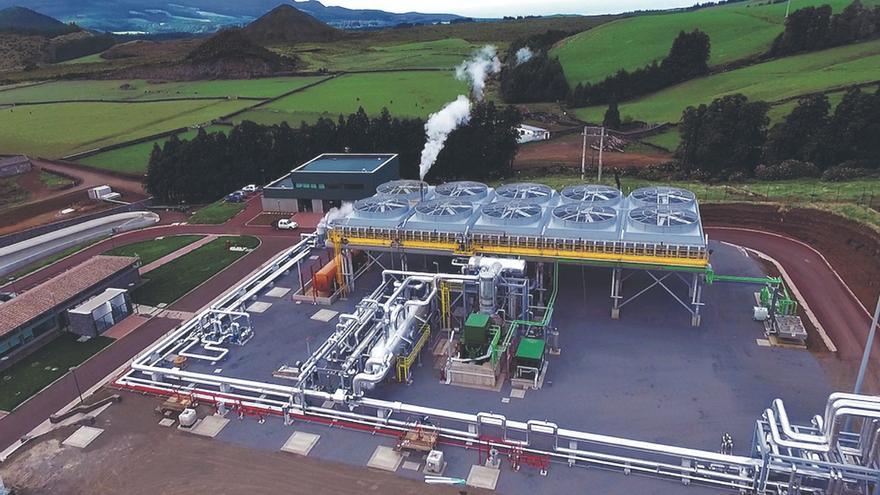
Tenerife studies the experience of the Azores in geothermal energy.
A delegation from Tenerife will visit the Azores to study the experience of using geothermal energy in order to implement it in the Canary Islands.
A large delegation from Tenerife is traveling to the Azores next Tuesday. There, they want to see how three large geothermal power plants operate. These plants use the earth's heat to generate energy.
The delegation will include representatives from the local government (Cabildo), the government of the Canary Islands, and private companies. They want to study how the Azores use renewable energy from the earth's interior. This will help them understand how such a system can be implemented in Tenerife.
The delegation will be led by the President of the Cabildo, Rosa Dávila. They will be in the Azores on Tuesday and Wednesday. The Azores, like the Canary Islands, Madeira, and Cape Verde, are part of Macaronesia. There are already three geothermal plants operating in the Azores, and the delegation wants to visit them.
In Tenerife, they plan to start research to find out if there are geothermal sources on the island. The area of the municipality of Vilaflor is of particular interest. If all goes according to plan, the research will begin before the end of this year.
The Azores have already found and are using geothermal energy. This gives hope that such an energy source also exists in Tenerife, as both islands have a similar geological structure and volcanic origin. In the Azores, which has a population of 236,000, there are three large plants that generate electricity from the earth's heat. This is completely clean energy. Two plants are located on the island of São Miguel, which has a population of over 130,000, and one is on the island of Terceira, which has a population of 53,000.
Geothermal energy already plays an important role in the energy supply of the Azores. It covers 42% of the needs of São Miguel and 11% of the needs of Terceira. Thanks to its focus on ecological development, this region has become an example for other volcanic islands. That is why the delegation from Tenerife decided to visit the Azores.
In addition to Rosa Dávila, the trip will include the Councillor for the Environment, Blanca Pérez, the Councillor for Innovation, Juan José Martínez, as well as representatives from the energy company DISA and the Icelandic company Reykjavik Geothermal. The Cabildo is working with these companies through the Institute of Renewable Energy Technologies (ITER) and the Volcanological Institute of the Canary Islands (Involcan). Together, they have created a consortium that will focus on the use of geothermal energy in Tenerife.
The Cabildo has launched a major project in Vilaflor to use heat from the earth's interior to generate clean electricity. This project is led by the Energía Geotérmica de Canarias (EGC) consortium. Juan José Martínez says that the goal of the project is to make Tenerife a leader in geothermal energy in Spain. This will help diversify electricity sources, become energy independent, and create a more sustainable energy system.
The project has received €43.2 million in funding from the Spanish government and the European Union. The total cost of the project is €86 million. Half of the amount is provided by investors and the other half by the state.
In 2024, geophysical surveys began in Tenerife to find promising sites for geothermal energy extraction. Such sites have been found in the south and west of the island. At the end of 2024, it is planned to obtain exploration permits, and at the end of 2025, to start drilling wells with a depth of 2500-3000 meters. These wells are to confirm whether thermal energy can be extracted in the form of hot water and steam on an industrial scale. If the results are positive, geothermal power plants will begin to be built in Tenerife.
"If we find this energy in the depths of the island, we can take a big step towards a more reliable and cleaner energy system," says Martínez. Geothermal energy is considered an inexhaustible, stable and local source of energy, which is ideal for islands like Tenerife.
Unlike other renewable energy sources, the earth's heat is available 24 hours a day, 365 days a year, regardless of the weather. This allows electricity to be generated constantly and predictably. In addition, once resources are discovered and confirmed, the cost of producing geothermal electricity is very competitive.
"Replacing thermal power plants that run on fuel oil or gas with geothermal plants will reduce greenhouse gas emissions," Martínez emphasizes. He also recalls that thanks to geothermal energy, the Azores save on the purchase of 122,000 barrels of oil per year.