
41st Canary Islands Handicraft Fair Opens in Tenerife
The 41st Canary Islands Handicraft Fair, running until December 8 at the Santa Cruz de Tenerife Exhibition Center, showcases over 140 artisans, celebrates traditional Canarian clothing, and promotes the preservation of island craft heritage.
The 41st Canary Islands Handicraft Fair opened at the Santa Cruz de Tenerife Exhibition Center, enjoying unusually good weather for November. Running from December 5 to 8, the fair brings together professional artisans who showcase their skills through masterclasses, workshops, and live music. This year, the event celebrates traditional Canarian clothing. Over four days, more than 140 artisans will display their creations, making Tenerife a vibrant hub for both traditional and innovative crafts from across the islands.
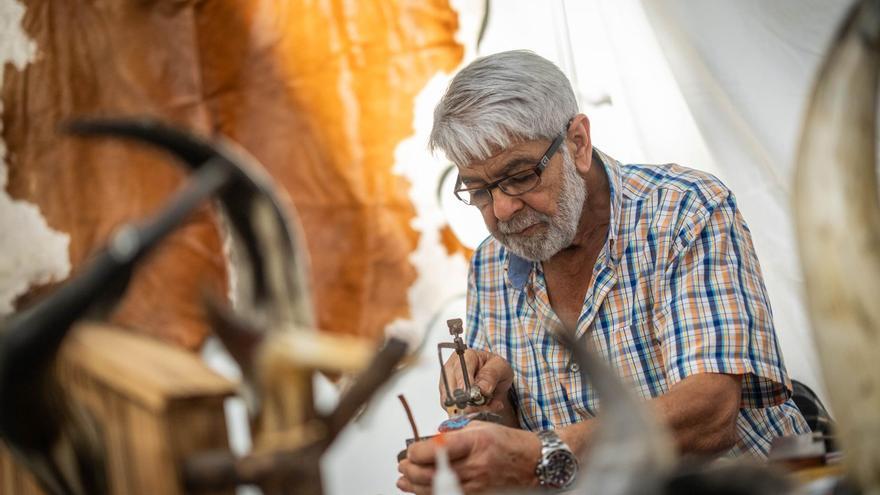
Inside a small, wood-scented stall, David Guijarro sits, carving a mortar from a raw piece of wood. He explains that all his pieces, including the mortars, are hollowed out by hand. His goal is to revive and preserve traditional items used centuries ago, before other materials existed. He believes it's crucial to create these traditional pieces because, as he puts it, "they are being lost."
Guijarro started woodworking at 16 or 17 and has been doing it for nearly forty years. However, he admits it's hard to make a living solely from his craft. He says, "Being a traditional artisan is tough financially; it doesn't bring in much money, just enough to get by." His wife, who also works in goldsmithing alongside her main job, provides the financial stability that allows him to focus on woodworking, for which he is very grateful. Despite the financial struggles, his biggest concern isn't money, but a lack of public understanding. He laments, "We've progressed in valuing handmade and traditional crafts, but we've also gone backwards due to misinformation."
Another "serious" problem, Guijarro explains, is when important pieces disappear without anyone noticing their value. He states, "We don't know enough about our own heritage or appreciate what we have." His voice grows firm as he remembers people burning Victorian chairs and cedar chests in San Juan bonfires. This, he says, is a result of "not knowing the value of our own things."
The fair aims to fight against this loss of heritage. At the opening, Efraín Medina, the Councillor for Employment, Education, and Youth for the Cabildo de Tenerife, emphasized that craftsmanship "is a legacy connecting us to our roots and creating future opportunities for young people." As he spoke, visitors began to fill the aisles, exploring stalls filled with ceramics, textiles, jewelry, leather, glass, local food, traditional costumes from each island, and woodworking.
Near the stage, visitors quietly watch Antonio Rodríguez and his team crafting intricate openwork, rosettes, palm baskets, gaiters, and hats. One colleague's hands move swiftly as she sews, almost instinctively, as if guided by memory. Rodríguez explains, "Making a rosette can take anywhere from ten or fifteen minutes to two full days of work."
Hats are similar; the time needed depends on how wide the braiding is. Every piece demands patience. A few meters away, a couple watches, amazed. Jorge González comments, "It's sad to think these crafts could disappear. Without fairs like this, many of us wouldn't even know they exist."
Tradition continues at a stall where a loom hums with a steady rhythm. Valentín Berradre, a weaver for nine years, moves the threads with natural ease. He explains, "I started because I fell in love with this craft," learning from "the best weaver in the Canary Islands," Tomás Hernández Negrín. His shawls combine 16th-century patterns with designs inspired by triangular, circular, and even butterfly-shaped aboriginal pintaderas (stamped designs). He comments, "For me, weavers are like interpreters and composers. Each fabric is like a melody." A woman stops at his stall, carefully examining each shawl. Eulalia Gómez confesses, "My grandmother also wove, and seeing him do it live has really touched me."
In the center of the Exhibition Center, the Cabildo de Fuerteventura's stall offers a live craft class. At a table laden with Canarian palm threads and wheat straw, two students craft a hat under the watchful eye of their master artisan. Lolina Negrín, the Councillor for Majorera Crafts (from Fuerteventura), explains that the hats on display can't be learned in a short 20 or 40-hour course. She notes, "It can take a year or two to gain the skill needed to create them."
In another corner, José Antonio Díaz shares how he started his craft. He began cabinetmaking – a type of carpentry focused on furniture – in 1986, through a course from the National Employment Institute (INEM). He had to choose between ceramics, wood, or leather, and "I chose wood." His designs are inspired by Canarian pintaderas. He explains, pointing to jewelry boxes with pintadera shapes on their lids, "Being Canarian, my designs always lean towards that style."
Further along, a stall with striking colors catches visitors' eyes. It belongs to Agustina Santini, a glass artist from Tenerife, who displays jewelry and other glass pieces inspired by church stained-glass windows. She recalls, "When I was a child, I was fascinated by the colorful stained-glass windows in churches. Over time, I learned the technique, starting by copying them, and then moved on to jewelry."
José Carlos Marrero sums up what many feel when they see these unique pieces: "Here you understand that each one has a soul, that it's not just another object, but something with a history." The fair offers a blend of tradition and learning, along with music, workshops, and live demonstrations. Children eagerly approach, asking "what are you doing," "how do you do it," and "why." Many families also visit the Exhibition Center, taking advantage of the December long weekend to enjoy the Canary Islands Handicraft Fair experience.
This year's program is especially appealing, featuring 14 workshops and four masterclasses over the four days. The first masterclass, led by Alberto Sosa and Marta Pérez, will focus on the uses and customs of scarves and sashes. Opening workshops include activities for adults, like building percussion instruments with Nayra Pérez, and fun for children, such as coloring and cut-out activities of traditional clothing.
Workshops will last two hours, with a maximum of 10 participants to ensure everyone gets personal attention. The fair will also highlight the Canarian rosette, which was recently recognized as an Intangible Cultural Heritage Asset.
The 41st Canary Islands Handicraft Fair is open to the public from 10:00 AM to 9:00 PM, and on Monday from 10:00 AM to 7:00 PM. Admission is free, offering both locals and tourists a special chance to discover, appreciate, and buy unique handmade items from the islands.