
1,544-Year-Old 'Tara' Named Europe's Oldest Tree in Teide National Park
Scientists in Teide National Park have discovered 11 ancient Canary Island cedars, including 'Tara,' a 1,544-year-old tree now confirmed as Europe's oldest living tree.
Scientists working on a project to replant and protect Canary Island cedars in Teide National Park are thrilled with their progress. They've discovered 11 ancient cedar trees, all over 1,000 years old. Three of these are even older, at over 1,500 years, while the other eight are over a millennium. These trees "escaped the axe," as climber Javier Martín Carbajal put it, referring to their discovery.
Biologists on the project, including José Luis Martín Esquivel, call this a "great discovery." They believe it suggests a large cedar forest once thrived in Las Cañadas. As part of their replanting efforts, the Cabildo de Tenerife and the Endesa Foundation have already planted 17,000 new cedars. Since 2019, they've been searching for and carbon-dating trees, a process that will continue until 2025. So far, 25 trees have been dated. These ancient trees, found in hard-to-reach places, "offer a unique glimpse into the park's ecological past," explained the island's government. They also "highlight the Canary Island cedar's importance as a symbol of resilience, biodiversity, and environmental history."
Of the three cedars over 1,500 years old, the most remarkable is 'Tara.' This fertile, fruit-bearing tree, found in Teide National Park, is now considered the oldest living tree in Europe. At 1,544 years old, Tara is older than 'Bárbol,' which previously held the record as Europe's oldest tree. While the presence of such ancient cedars in the park was known for some time, Tara's official naming was announced on Monday, December 1st.
"It's feminine, so we decided to name her Tara," said climber Javier Martín Carbajal, who helped discover the tree. He and three others regularly explore the park's steep terrain, looking for more cedars. Tara grows on a cliff face in the Roques de García, 150 meters up. "You won't find it," Martín Carbajal joked, highlighting how hard it is to reach.
Martín Carbajal, a conservationist from Tenerife, has been climbing in the park for 40 years. He once told park biologist José Luis Martín Esquivel that he knew of a cedar likely older than 'El Patriarca,' another cedar dated at 1,118 years old. When Martín Esquivel saw Tara, he simply said, "It's like an open book waiting to be read," Martín Carbajal remembered.
Tara was discovered several years ago, and its study is part of the reforestation and conservation project led by the Cabildo de Tenerife, the Endesa Foundation, and the University of Valladolid. Martín Carbajal believes there are cedars "in all the steep slopes of Las Cañadas." He finds it "incredible how they survive there," and also how people managed to reach and cut down cedars in such inaccessible spots using ropes. He added that more trees in Teide National Park still need to be analyzed, so Tara might not hold the title of longest-living cedar forever.
"At Fundación Endesa, we partner with national parks on biodiversity projects to protect natural heritage," said Juan Ignacio Ferrer, head of Biodiversity at Fundación Endesa. He added that restoring the cedar forests in Teide National Park "is a unique chance to bring nature back into balance and restore a landscape as precious as Teide's."
José Miguel Olano, a professor at the University of Valladolid, noted that "this discovery shows how practical science and partnerships between public and private organizations can deliver real results in protecting our natural heritage. Canary Island biodiversity is a treasure we must protect with determination."
Beyond the cedars, another project, a collaboration with Fundación Endesa and the Agroforestal company, focuses on recovering the silver thistle (Rhaponticum canariense) and the Teide violet (Viola cheiranthifolia). This effort recently saw 65 Teide violets and 50 silver thistles reintroduced to two new spots in the national park.
Martín Esquivel explained that while the most threatened species now number in the thousands, "they are still at risk, though not on the verge of extinction."
The Teide violet, mostly found in Guajara, was nearly "wiped out by the fires that ravaged the south of the island a few years ago (2023)," Martín Esquivel said. This prompted an urgent search for a second location to prevent its total destruction by a single event. "We now have a second population in the 'sombrerito de Chasna'," he added.
The silver thistle, once one of the world's most endangered species with fewer than 200 known plants a few decades ago, now numbers in the thousands. However, Martín Esquivel noted a new challenge: "At higher altitudes, the species is starting to suffer from climate change." To ensure its survival, it was moved to a new, higher location on the slopes of Teide, at about 2,800 meters.
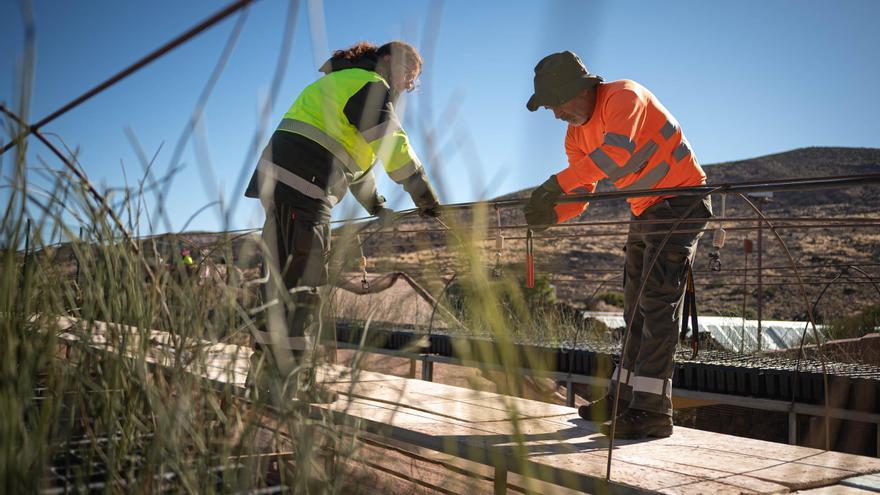
Martín Esquivel expressed his satisfaction with the conservation work in Teide National Park. He outlined the project's stages, from the 'seedbed' – where "practically magic happens" – to the nursery. He explained that finding and separating seeds is a difficult and time-consuming task. Ángel Mallorquín, who coordinates these early stages, added, "Each seed has its own process. There isn't one formula for all; each has its particular needs, so the process varies depending on the seed."
One clever way to save time is to collect seeds from bird droppings. Martín Esquivel explained that the white-capped blackbird, which migrates from northern Europe, eats cedar fruits and then disperses the seeds. "This method speeds up the process by six months," he estimated.
After the seed bank, the seeds go to the nursery, which they call "the seeds' daycare." Once they are young plants, they undergo an acclimatization phase, where they are exposed to the park's harsh conditions. Finally, they are planted back in their original areas, protected by fences to stop herbivores from eating them.